At Applied Conveyor Technology (ACT), dust control is in the company’s DNA — two of the three companies that formed the group did nothing else. From Fontana, in the middle of the Inland Empire, we design, install, service and supply industrial dust collection and dust control systems for cement, aggregate, mining and processing plants across Southern California and the West Coast.
At Applied Conveyor Technology (ACT), we understand that dust is never just a housekeeping problem. It is an air-district citation waiting to happen, a combustible-dust hazard nobody has analyzed, a bearing that fails early, and a neighbor with a phone. Since 1991 we have handled all of it — Air Pollution Control Services and Dustco, two of the companies that make up The ACT Group, were built entirely around dust collection and dust suppression. Today that means one crew that can design a system, install it, keep the baghouse breathing, stock the filters, and suppress the dust the collector can’t reach.
Compliance Without Drama: Southern California has the strictest air rules in the country — South Coast AQMD Rule 403 on fugitive dust and Rule 1157 on aggregate operations, plus the Mojave Desert, San Joaquin Valley and San Diego districts. We build systems that pass, and we keep them passing.
Combustible Dust Safety: If your dust burns — wood, grain, coal, biomass, many plastics and metals — NFPA 660 applies to you. We handle dust hazard analysis and the protection hardware that follows.
Uptime, Not Just Air Quality: A baghouse that plugs or a collector that pulls the wrong CFM shuts down the process behind it. Our service program keeps the collector out of the critical path.
System design and installation: Hood capture, duct sizing by the ACGIH velocity-pressure method, collector selection and fan sizing — engineered in-house and fabricated in our 18,000 sq/ft Fontana shop. Start with our free Dust Collection System Designer and we’ll review the draft with you.
Baghouse and dust collector servicing: Bag and cartridge change-outs, cage and venturi replacement, leak detection, pulse-valve and timer repair, hopper and airlock work, differential-pressure troubleshooting and complete rebuilds — on any brand of collector. See baghouse & dust collector servicing.
Replacement filters in stock: Donaldson, Camfil, Imperial Systems, UAS, Nederman/Pneumafil and RoboVent cartridges and bags on the shelf in Fontana, with cross-references for everything else. See dust collector replacement filters.
Dust suppression: High-pressure fog, spray and foam systems with surfactants for truck dumps, crushers, transfer points and stockpiles — the dust a collector can’t reach. See dust suppression systems.
Industrial ventilation: Local exhaust and general ventilation for fume, heat and fine particulate in processing buildings. See industrial ventilation.
Explosion protection and dust hazard analysis: NFPA 660 compliance reviews, isolation, venting and suppression hardware for combustible dust. See explosion protection.
Source-by-source dust mitigation: Transfer-point enclosures, skirting, belt cleaners and containment for existing plants that leak dust at a dozen small places. See dust mitigation.
Scheduled dust control programs: Inspections, filter changes and documentation on a calendar through ACTAssure™, so the air district never finds something you didn’t already know about.
We work from 14644 El Molino St. in Fontana, which puts Ontario, Rialto, Colton, Riverside, Corona, San Bernardino and the rest of the Inland Empire within a short drive, and Los Angeles, Orange County, San Diego, the High Desert and the Central Valley within a day’s work. Beyond California we serve Nevada, Arizona, Oregon and Washington — licensed in California (#700731) and Nevada (#0072789). Our dust collection work for Tesla and our air-cannon and belt work for CalPortland and National Cement are on the blog if you want to see how we operate.
Cement and lime, aggregate and asphalt, mining and minerals, recycling, biomass and wood products, food and feed processing, foundries and metalworking, ports and bulk terminals — anywhere dry material moves and an air district is paying attention.
Notice of violation in hand, a collector that won’t hold pressure, or a new line that needs air? One call reaches engineers, service crews and the parts shelf. Since 1991, the plants that call us tend to keep calling.
Pair this service with baghouse & dust collector servicing and in-stock replacement filters, try the free System Designer, or contact our team for a fast quote.
Service areas: Inland Empire · Los Angeles
Capture it at the source, or chase it forever
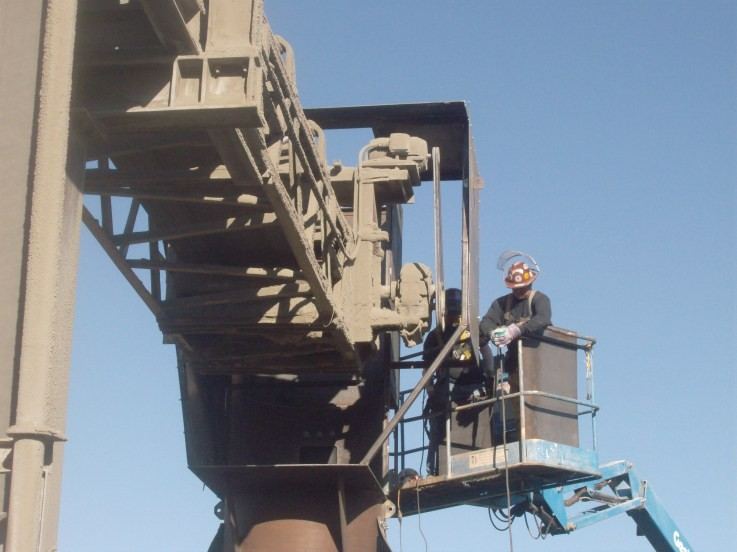
Plants buy bigger collectors to fix dust that is escaping three feet from a badly placed hood. Capture velocity at the source, duct velocity that keeps material moving, and a collector sized to the real airflow — get those three right and the fan is rarely the problem. That is why every ACT dust project starts with a walk-down, not a catalog.
Cartridges and bags for the collectors we see most, ready for same-day pickup or delivery with the service call.
Brands we stock: Donaldson · Camfil · Imperial Systems · UAS · Nederman & Pneumafil · RoboVent
Usually. South Coast AQMD and the other California districts require permits to construct and operate most industrial dust collectors, and some exempt only very small units. We're not your permit attorney, but we prepare the engineering data the application needs — airflow, emissions, control efficiency — and we've done it many times in this district.
Collection pulls dust-laden air through a hood and duct to a filter and returns clean air. Suppression keeps dust from going airborne at all, using fog, spray or foam at the point it's created. Enclosed processes want collection; open transfer points, truck dumps and stockpiles usually want suppression. Many plants need both, and we do both.
By differential pressure and emissions, not by the calendar. A collector that runs high dP after cleaning cycles, or shows visible emissions or a stack-test drift, is telling you. Most plants land somewhere between one and three years for bags, less in abrasive or high-moisture service. Our service program tracks it so the change happens before the citation.
Wood, grain, sugar, coal, biomass, many plastics and most metal dusts are combustible. NFPA 660 — the consolidated combustible-dust standard — requires a dust hazard analysis for facilities that handle them, and drives isolation, venting and suppression on the collector. We perform the analysis and install the hardware.
Yes. We service every major brand — Donaldson Torit, Camfil, Imperial Systems, UAS, Nederman, RoboVent and older baghouses nobody remembers the maker of. If parts are still made, we can get them; if they're not, we can usually adapt.
It walks you through six steps — sources, hoods, duct runs, collector, fan, combustible-dust flags — and produces a draft system using the ACGIH velocity-pressure method in about ten minutes. It's a real engineering first pass, not a lead form. Bring the draft to us and we'll turn it into a system.
Suppression versus collection versus ventilation, how a baghouse actually works, differential pressure, combustible dust and NFPA 660, and a free tool that drafts your system in ten minutes. Free reading, no forms.
Dust Collection 101 →Suppression vs. collection vs. ventilation →Applied Conveyor Technology — bulk material handling experts. Dust control, conveyor services, silo cleaning, parts, and engineering.
909-350-4703
888-480-0680 (toll-free)
Industrial Services
Industrial Parts
About Us
Blog
Contact
Service Areas
Silo Cleaning: Inland Empire · Los Angeles · Nevada
Dust Collection: Inland Empire · Los Angeles
Belt Vulcanizing: Los Angeles · Nevada
© 2026 The ACT Group (Applied Conveyor Technology). All rights reserved.
Field-tested fixes, new parts, and plain-spoken advice from the ACT crew. An email now and then — no spam, unsubscribe anytime.