
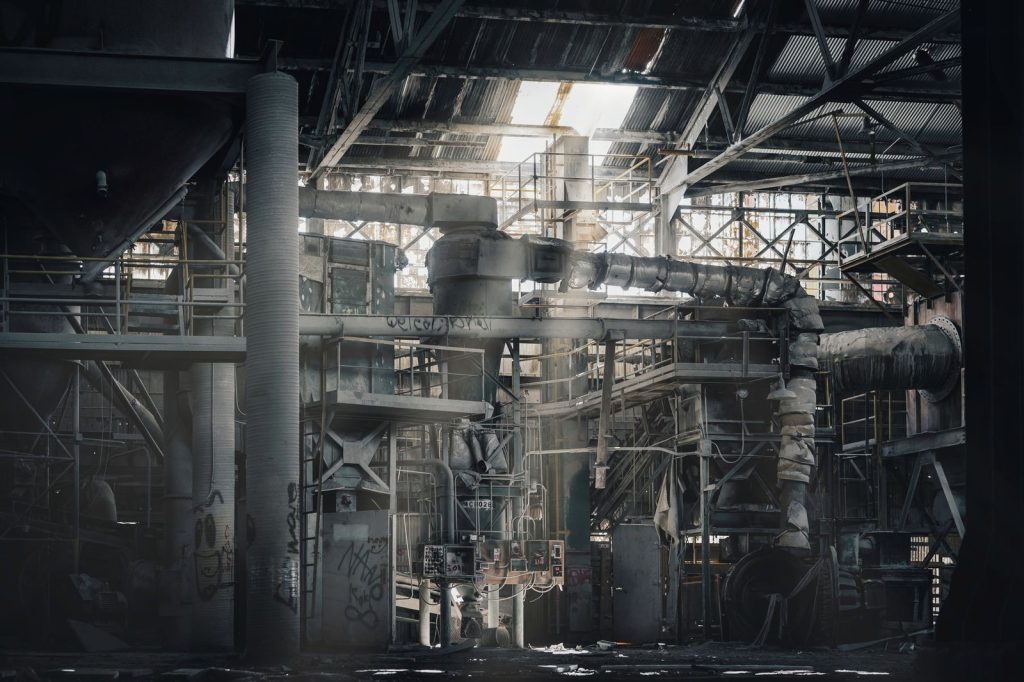
Take a business card and look at its edge. Now picture a dust layer half that thick sitting on the beams above your production floor. NFPA guidance has historically treated accumulations as thin as 1/32 of an inch — over a sufficient area — as enough to constitute a combustible dust hazard.
That is not a legal limit, and it is not a number written into a regulation. It is a rule of thumb from NFPA guidance. But it is the rule of thumb inspectors, fire marshals, and insurance engineers carry in their heads, and it is a useful way to calibrate your own eye. If you can write your name in the dust on a ledge, you are well past it.
Why the thin layer matters
The layer on the floor is not what destroys buildings. Secondary explosions are.
The sequence is well documented in incident investigations: a small initial event — a fire in a collector, a deflagration in a piece of equipment — sends a pressure wave through the building. That wave shakes loose every dust layer sitting on beams, ledges, ducts, and equipment tops, throwing it into the air as a cloud. The fireball from the initial event ignites the cloud, and the secondary explosion is far larger than the first. The dust that fuels it is precisely the dust nobody cleaned because it was forty feet up and out of sight.
This is why NFPA 660 treats housekeeping as a control measure, not janitorial work. Fugitive dust on elevated surfaces is stored fuel.
The surfaces that matter most
Walk your plant and look up. The priority list, roughly in order of how often it gets missed:
- Structural steel — top flanges of beams and joists, horizontal bracing
- Tops of equipment — collectors, cabinets, motor housings, tanks
- Ductwork and pipe runs — especially wide horizontal duct, which is effectively a shelf
- Cable trays and conduit racks
- Light fixtures — dust on a hot fixture is both fuel and ignition risk in one package
- Ledges, sills, and the tops of walls and partitions
- Above suspended ceilings — out of sight for years at a time
- Inside enclosures and pits — electrical rooms, elevator boots, under conveyors
Floors get swept because people see them. The hazard lives everywhere people do not.
Cleaning methods: what is safe and what is not
How you remove the dust matters as much as whether you do.
Vacuuming is the preferred method. It captures dust instead of relocating it. For combustible dust, that means equipment suited to the hazard — industrial vacuums designed for combustible dust service, or a fixed central vacuum system, not a shop vac from the hardware store, which can be an ignition source itself.
Sweeping and brushing are acceptable where done gently enough to avoid raising a cloud, ideally with the dust dampened if the material allows.
Compressed air blowdown is where plants get in trouble. Blowing dust off surfaces with an air lance does exactly what a pressure wave does in a secondary explosion: it puts a settled layer into suspension as a cloud. Doing that near any ignition source is how cleaning days become incident reports. NFPA guidance treats blowdown as a last resort, permitted only under tight conditions — surfaces inaccessible by other methods, ignition sources controlled or shut down first, and typically after vacuuming has removed the bulk of the accumulation. If blowdown is your primary cleaning method, that is a finding waiting to be written.
A related trap: using the same compressed air to blow dust off clothing. Same physics, closer to your skin.
Building a schedule that survives an audit
A housekeeping program that exists only as a habit dies with staff turnover and gets no credit in an audit. What holds up is boringly specific:
- Map the zones. Divide the plant into housekeeping zones and list the surfaces in each — including the elevated ones. If the DHA identified accumulation areas, those drive the map.
- Set frequencies per zone. Areas near generation points (transfer points, loadout, screening) need frequent attention; remote elevated steel might be quarterly or semiannual. The frequency should be based on how fast dust actually accumulates there — go look, do not guess.
- Define the method per surface. Vacuum by default. Note where dampened sweeping is allowed and where (if anywhere) controlled blowdown is authorized, with its preconditions spelled out.
- Assign names, not departments. “Operations” never cleaned anything. A named person per zone with a checklist did.
- Log completion. Date, zone, initials. A clipboard or a tablet form — the format does not matter, the record does. When an inspector asks how you manage dust accumulation, a year of completed logs is the difference between a conversation and a citation.
- Set an action trigger. Define the level of accumulation that triggers immediate cleanup outside the schedule — the 1/32-inch rule of thumb is a defensible benchmark — and make supervisors responsible for calling it.
- Audit it yourself. Once a quarter, someone other than the assigned person walks a zone and checks reality against the log.
Fix the source, then the schedule shrinks
If your crews are cleaning the same surfaces every week, the dust is escaping somewhere it should not. Chronic accumulation usually traces to a fixable source: transfer points with worn or missing containment, belt carryback that a proper cleaner would remove, leaking duct connections, or a dust collection system that no longer pulls design airflow. Every pound captured at the source is a pound nobody has to vacuum off a beam. The economics tend to favor containment quickly once you count the labor honestly — housekeeping hours are perpetual; a sealed transfer point is not.
The bottom line
The dust layer on your overhead steel is the cheapest hazard in the plant to find — a flashlight and a ladder — and one of the worst to ignore. Set the schedule, pick safe methods, keep the log, and chase the accumulation back to its source.
The ACT Group in Fontana has spent thirty-plus years helping Southern California plants stop dust where it starts — belt cleaners, transfer point containment, dust collection design, and baghouse service. If the same ledges keep filling up no matter how often you clean, call us and we will walk the plant and find out why.