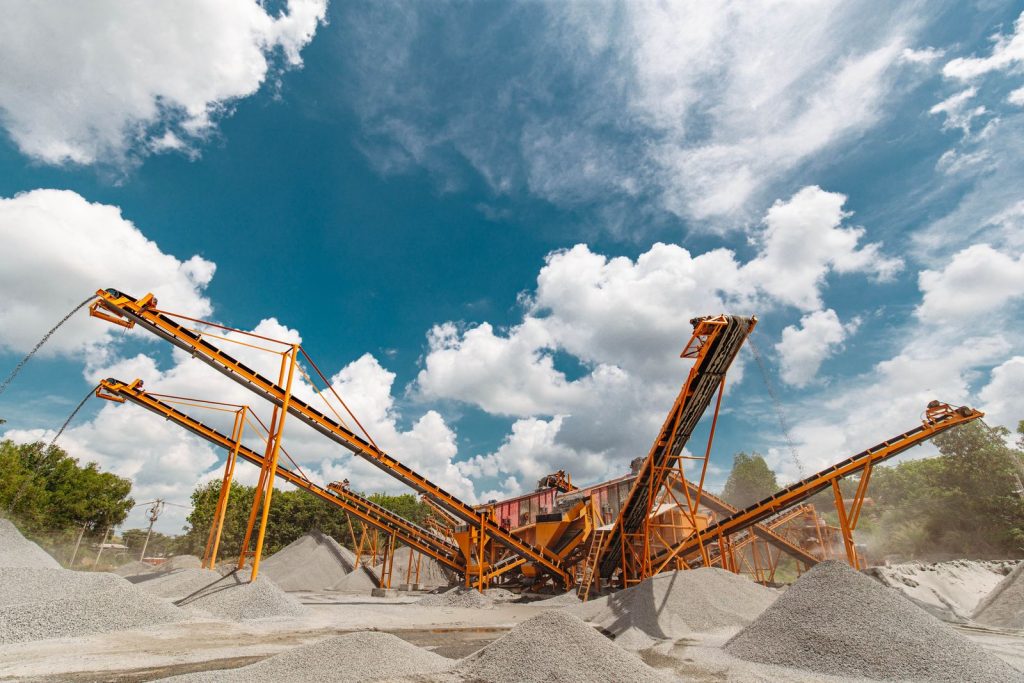
Walk a conveyor system with a flashlight after dark and you’ll see where the dust actually comes from. It’s not the carrying run. It’s the transfer points — every place material leaves one belt and lands on another. That’s where the housekeeping labor goes, where the MSHA or AQMD inspector points, and where the respirable dust exposure lives.
The instinct is to solve it with suction: hang a pickup on the chute, run duct to a collector, done. Extraction has its place, but it’s the last step in the hierarchy, not the first. If the transfer point is generating and ejecting dust, a collector is just an expensive way to chase it. The cheaper, more durable fix is to stop making airborne dust in the first place.
Why transfer points make dust
Three mechanisms do most of the damage.
Induced air. Falling material acts like a piston. As the stream drops through the chute, it drags air along with it, and that air has to go somewhere when the material lands. It exits the skirted zone at speed, carrying fines with it. The taller the drop and the more open the chute, the more air gets induced and the more dust gets pushed out of every gap.
Free-fall height and impact. Material that free-falls several feet doesn’t just entrain air on the way down — it shatters on landing. Every hard, uncontrolled impact generates new fines and launches the existing ones. Drop height is a dust-making machine, and most older chutes have more of it than the process needs.
Belt sag between idlers. Under the load zone, the belt sags between idlers. Every sag cycle opens and closes the gap between the belt and the skirt seal. That pumping action exhales dust with each idler pitch, and it also lets fines work under the skirting, where they grind the belt and spill onto the floor. You can’t seal a surface that’s moving up and down.
The containment hierarchy
Work these in order. Each step makes the next one cheaper and the last one — extraction — smaller or unnecessary.
1. Chute design. The biggest lever. A well-designed transfer chute controls the material stream instead of letting it fall: it keeps the material consolidated, reduces effective drop height, and lands the load in the direction of belt travel at close to belt speed. Less impact, less degradation, less induced air. Engineered “hood and spoon” style flow control is the standard approach; even partial corrections — a deflector that gathers the stream, a rock box in the right place for the right material — pay off.
2. Skirting and wear liners. The skirted area is your settling chamber. It needs enough enclosed length for induced air to slow down and drop its dust before it reaches open belt. Inside the chute, wear liners take the abrasion and are positioned to keep material off the seal. Outside, the skirt seal itself should be a proper sealing system — not a slab of old belt clamped to the steel, which wears a groove into the belt and seals nothing.
3. Dust curtains. Staged curtains inside the settling zone slow the airflow, knock down the dust-laden air stream, and give fines time to settle back onto the belt. They’re cheap, and they turn the skirted enclosure into a series of stilling chambers instead of a wind tunnel.
4. Belt support. None of the sealing works over a sagging belt. Under the load zone, replace standard idlers with impact beds or slider/combination beds so the belt runs flat and stable against the skirt seal. This is the step plants skip most often, and it’s why their new skirt rubber leaks within a month. Stabilize the belt line first; then the seal has something to seal against.
5. Sealing. With the belt supported and the chute enclosed, close the remaining paths: multi-layer skirt seals along the sides, a back seal at the tail, dust curtains at entry and exit, and sealed inspection doors. The goal is a slight resistance to airflow everywhere, so the enclosure can hold the pressure that induced air creates.
6. Extraction — last, and smaller. After steps 1–5, some applications still need active dust collection: very dry, very fine, high-tonnage material. But now the pickup is capturing what’s left, not fighting the full induced-air volume. That means a smaller insertable collector or a smaller branch off the baghouse, lower airflow, and less product carried away into the collector — product you paid for.
Retrofit or redesign?
You don’t always need a new transfer point. A fair rule of thumb from field work:
- Retrofit when the chute geometry is basically workable and the problems are sag, seal wear, and gaps. Impact beds, wear liners, modern skirting, curtains, and enclosure extensions bolt into most existing structures during a normal outage window.
- Redesign when the geometry itself is the problem — drop heights well beyond what the process requires, off-center loading that mistracks the belt, chutes that plug in wet weather, or a transfer that was built for a different material or tonnage than it runs today. Patching seals on a fundamentally bad chute is recurring cost with no end.
A quick self-audit for your worst transfer point:
- Is there dust visibly puffing from the skirting while the belt runs loaded?
- Is spillage collecting under the load zone faster than housekeeping clears it?
- Is the skirt rubber grooving the belt, or being adjusted more than quarterly?
- Does the belt visibly sag between idlers under load?
- Is the load landing off-center or against belt travel?
Two or more yes answers usually means the money you’re spending on cleanup and belt wear would fund the fix.
Fix the cause, then size the cure
Dust at a transfer point is a symptom of uncontrolled material and uncontrolled air. Control the stream, support the belt, seal the enclosure — then, if you still need extraction, it will be a fraction of the size you’d have specified on day one.
The ACT Group has spent more than 30 years engineering and servicing transfer points for aggregate, cement, and manufacturing plants across Southern California, from skirting retrofits to full chute redesigns, backed by a free online dust collection designer on our site for the extraction step. If one of your transfers is burying the crew in cleanup, get in touch with our Fontana office and we’ll walk it with you.