
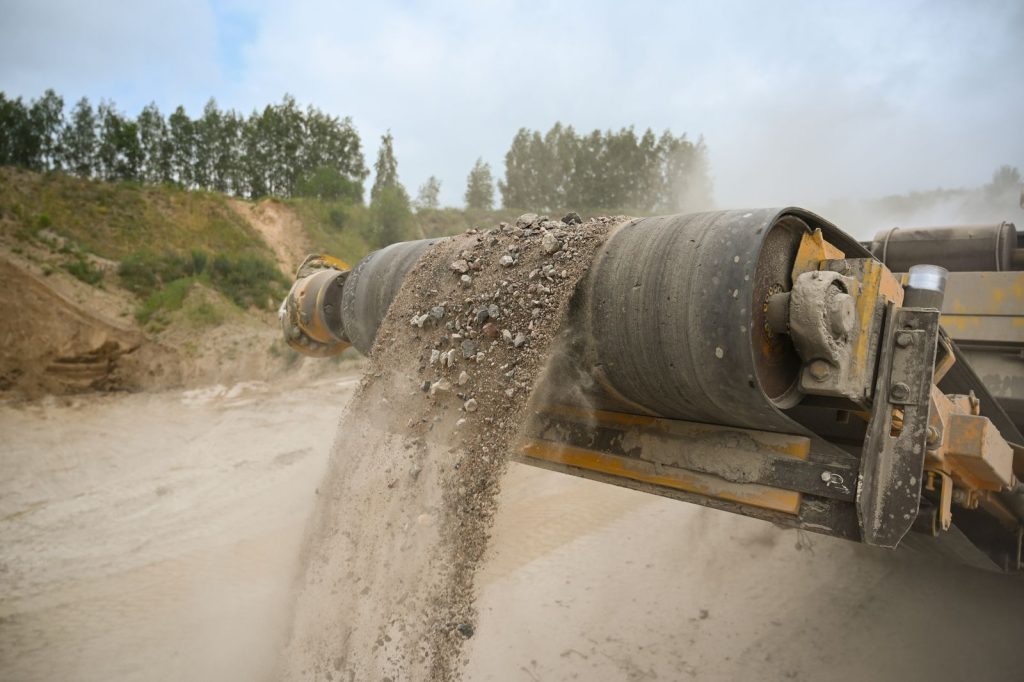
Walk under the return side of almost any conveyor at an aggregate, cement, or asphalt plant and you’ll see the same thing: fines and paste stuck to idlers, a coating on the snub pulley, and a windrow of spilled material along the stringers. None of that material fell off the head pulley where it was supposed to. It rode the belt back.
That’s carryback, and if nobody at your plant owns the problem, it is quietly costing you money every shift.
What carryback actually is
When the belt wraps the head pulley and dumps its load, some fraction of the material doesn’t leave. Fines, moist material, and sticky product cling to the belt cover and travel back down the return run. Somewhere along that run — usually within the first few return idlers — it lets go.
The wetter and finer the material, the worse it gets. A dry, coarse rock product might shed cleanly. Crusher fines with a little moisture, filter cake, or anything with clay in it will paint the belt and everything the belt touches.
Where the material ends up
Carryback doesn’t disappear. It relocates, and every place it lands creates a maintenance problem:
- Return idlers. Material builds up on the roll face, which changes the roll diameter unevenly. An idler caked on one side steers the belt. Buildup also packs into seals and kills bearings early.
- Snub and bend pulleys. Buildup on a pulley face does the same thing — it changes the effective profile and pushes the belt off line. Hardened buildup can also gouge the belt cover.
- Under-belt piles. The classic symptom. Piles form under the return run, and somebody with a shovel has to deal with them, often in a spot with poor access and live equipment overhead.
- The tail pulley. Whatever survives the trip back gets pinched between the belt and the tail pulley, which is one of the fastest ways to damage a bottom cover.
The hidden costs
Cleanup labor is the visible cost, and it’s real — carryback is one of the leading drivers of conveyor cleanup work in bulk handling plants. But it’s usually not the biggest line on the tab. Consider what else is on it:
- Idler and pulley wear. Seized return idlers from packed material become belt abraders. A frozen roll under a moving belt will cut a groove in the cover, and eventually into the carcass.
- Belt mistracking. Buildup on rolls and pulleys is one of the most common root causes of tracking problems. Plants spend money on training idlers to fight a problem that starts at the head pulley.
- Dust exposure. Dried carryback that drops off the return run becomes airborne dust — a housekeeping issue at best, a respirable silica exposure at worst. In California, that gets regulatory attention.
- Spillage hazards. Piles under conveyors are slip, trip, and access hazards, and shoveling near a moving belt is one of the higher-risk routine tasks in a plant.
- Lost product. Everything on the ground is material you crushed, screened, or processed and now can’t sell without rehandling it.
Primary vs. secondary cleaners
Most carryback problems trace back to a cleaning system that was never adequate for the duty, or one that was adequate once and hasn’t been maintained.
A primary cleaner (pre-cleaner) mounts on the face of the head pulley, just below the material trajectory. Its job is to peel off the bulk of the carryback — the heavy layer. Primary blades are usually polyurethane and run at relatively light contact pressure so they don’t attack the belt or splices.
A secondary cleaner mounts just behind the head pulley, where the belt has left the pulley face. It scrapes off the thin film the primary leaves behind. Secondaries often use metal-tipped blades — tungsten carbide is common — with a spring or cushioned tensioner. They’re the difference between “mostly clean” and “clean enough that the return run stays dry.”
On wet or sticky applications, one primary alone rarely gets you there. A primary and secondary working together is the standard arrangement. Severe cases add a tertiary cleaner or a belt wash station.
Blade selection and tensioning basics
A few practical points that solve most day-to-day cleaner complaints:
- Match the blade to the belt and material. Urethane hardness and blade profile should suit the belt speed, material temperature, and abrasiveness. Too soft and the blade wears out in weeks; too hard and it chatters or damages the cover. If the belt has mechanical splices, make sure the cleaner is rated to pass them.
- Cover the load path, not the whole belt. The blade needs to span the material path. Blades wider than necessary just add drag and extra wear points.
- Tension is a setting, not a suggestion. Under-tensioned blades let material tunnel underneath. Over-tensioned blades wear fast, heat the belt, and can vibrate. Follow the manufacturer’s tension spec and re-check it as the blade wears — most tensioners need periodic adjustment unless they’re a self-adjusting design.
- Inspect weekly. A cleaner is a wear part doing continuous work. A one-minute look — blade contact, wear pattern, buildup behind the blade, tensioner position — catches most problems before the shovel crew does.
Uneven blade wear tells you something too. Heavy center wear usually means the load path is concentrated there; one-sided wear often means the belt is mistracking at the head pulley or the cleaner pole isn’t square to the belt.
When to re-evaluate the cleaner instead of blaming the belt
It’s common to hear “that belt just runs dirty,” as if it were a property of the belt. Usually it isn’t. Re-evaluate the cleaning system when:
- Cleanup frequency under the return run is creeping up shift over shift
- Blades are being replaced far more often than the manufacturer’s typical life suggests
- The belt tracks fine empty but wanders loaded, and return components show buildup
- The material, moisture content, or throughput has changed since the cleaner was specified
- The belt has been replaced with a different cover compound or splice type since the cleaner was selected
A cleaner is specified for a duty: belt width and speed, material, moisture, pulley diameter, available mounting space. Change any of those and the original selection may no longer fit. Sometimes the fix is a blade change; sometimes it’s adding a secondary; sometimes the mounting location was wrong from day one.
A quick self-check
- Is there a pile under the return run right now?
- When were the cleaner blades last inspected and tensioned?
- Do you know what blade material is on each cleaner, and why?
- Are return idlers failing early because of buildup?
- Who at the plant owns belt cleaning performance?
If the answers are “yes, no idea, no, yes, and nobody,” the carryback bill is bigger than it looks.
The ACT Group in Fontana has spent more than 30 years helping Southern California plants get carryback under control, from blade selection and tensioning to full transfer point rework. If you’ve got a conveyor that runs dirty, give us a call — we’re glad to walk the belt with you and put numbers to the problem.
Ready to run clean? Browse our belt cleaners — including Uni-Blade™ replacement blades that fit Martin®, Flexco®, Asgco®, and more — or have our crew walk your belt.