
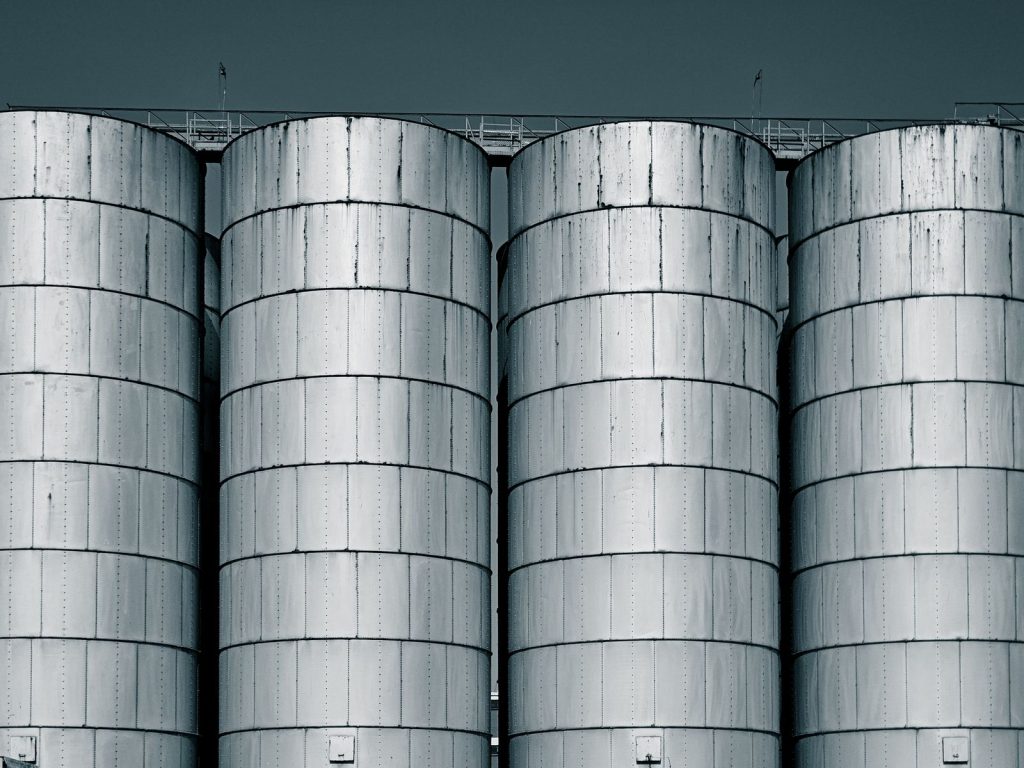
Every silo and bin starts out with a rated capacity. Very few keep it. Material clings to walls, hardens above the outlet, and slowly turns a 500-ton vessel into a 300-ton vessel that still shows “full” on the level sensor. If you store cement, fly ash, lime, sand, or just about any bulk powder or aggregate fines, buildup is not a question of if — it’s a question of how much you’ve already lost.
Here’s why it happens, what it costs you, and where the line sits between a maintenance task and a job for a professional cleaning crew.
Why material builds up
Moisture. This is the big one. Moisture gets in through vents, leaky roof seams, humid ambient air, or the material itself arriving wetter than spec. Hygroscopic materials like cement and lime pull moisture out of the air and start to hydrate right on the wall. Once a thin crust forms, it gives the next layer something to grab onto.
Compaction. Material at the bottom of a tall column carries the weight of everything above it. Fine powders consolidate under that pressure, especially when they sit undisturbed. A silo that gets turned over weekly behaves very differently from one that holds “safety stock” for six months.
Temperature cycling. In Southern California, the swing between a hot afternoon and a cool night drives condensation on the inside of steel silo walls, day after day. That condensation wets the material at the wall face — exactly where buildup starts. Seasonal cycling does the same thing on a longer clock.
Material segregation. When material free-falls into a silo, fines drift to the walls and coarse particles land in the center. The fine fraction at the wall is the fraction most prone to packing and caking, so the vessel effectively builds its own liner out of its worst-flowing material.
What buildup costs you
- Lost live capacity. Wall buildup a foot or two thick around a large silo can quietly remove a meaningful share of usable storage. You buy material more often, in smaller lots, and your buffer against a supply hiccup shrinks.
- Ratholes. In a funnel-flow vessel, a stable vertical channel can form above the outlet while the surrounding material stands still. The silo discharges only what falls down the pipe. Your level sensor reads the top of the stagnant material and tells you a story that isn’t true.
- Flow stoppages. Bridging — hardened material arching across the cone above the outlet — stops discharge entirely. Now production is waiting on storage, and someone is reaching for a hammer or an air lance.
- Structural loading concerns. Silos are engineered for reasonably symmetric loads. Heavy buildup on one wall, or a large mass letting go all at once during discharge, creates eccentric and impact loads the designer never intended. Dents, buckled skirts, and cracked cone welds are the visible end of that story.
Warning signs worth acting on
- Discharge rate has slowed, or flow surges and stalls instead of running steady.
- Inventory counts keep drifting — the silo “holds less than it used to,” or reconciliation never matches the level reading.
- Operators are banging on the cone with hammers, or air pads run constantly just to keep material moving.
- Level sensor readings that don’t change when you know material went in or out.
- Visible dents or bulges in the cone or lower shell — stop and get an engineering look before anything else.
What you can reasonably do in-house
Some of this is legitimate plant maintenance:
- Keep roof hatches, vents, and seams sealed so weather stays out.
- Maintain the bin vent or baghouse on top of the silo — a plugged vent filter drives moisture and pressure problems into the vessel.
- Manage turnover: first-in, first-out, and don’t let one silo become the permanent parking spot for old material.
- Use installed flow aids — air pads, vibrators — per their design, not as a substitute for cleaning. A vibrator run against a bridged outlet can compact the blockage tighter and stress the structure.
Where the DIY line ends
The line is the manway. The moment the fix requires a person inside the vessel — or someone standing on top of stored material to knock it loose — you are out of maintenance territory and into a fatality scenario.
A silo is a permit-required confined space under OSHA 29 CFR 1910.146: limited means of entry and exit, not designed for continuous occupancy, and containing a serious engulfment hazard. Compliant entry means a written permit program, atmospheric testing, an attendant, retrieval equipment, and trained personnel. And no one — ever — should be inside a silo standing on stored material. Crusted material that looks solid can collapse without warning, and engulfment in flowing bulk material is routinely fatal. It takes seconds, and there is no digging someone out in time.
Professional silo cleaning avoids that problem by staying outside the vessel. The standard tools:
- Whip cleaning. A boom lowered through a roof opening spins flails or cutting heads that knock buildup off the walls, working top-down so nothing hangs above the work. No one enters the silo.
- Auger and boring systems. When a silo is bridged or packed nearly solid, a drilling system bores a pilot column down through the blockage from the top, re-establishing a flow channel so the whip work can proceed.
- No-entry as the default. A competent contractor treats entry as a last resort under a full permit program, not the starting plan.
Done right, the crew removes the buildup down to the wall, the material discharges through your normal outlet as they work, and you get your rated capacity back — along with a look at wall condition that has been hidden behind buildup for years.
When to make the call
If you’re seeing ratholing, bridging, chronic slow discharge, or inventory that won’t reconcile, the buildup is already past the point where housekeeping fixes it. Scheduling a cleaning during a planned outage beats doing it during an unplanned one, every time.
The ACT Group in Fontana has been cleaning silos and bins for Southern California aggregate, cement, ready-mix, and manufacturing plants for over 30 years, using no-entry whip and auger methods with safety as the first constraint. If one of your vessels is showing the signs above, reach out and we’ll take a look before it becomes a shutdown.
Ready for a quote? Tell us about your vessel with the Silo Solutions Data Form — dimensions, material, and the problem you’re seeing — and we’ll price it with no obligation. Prefer paper? Download the printable PDF.