
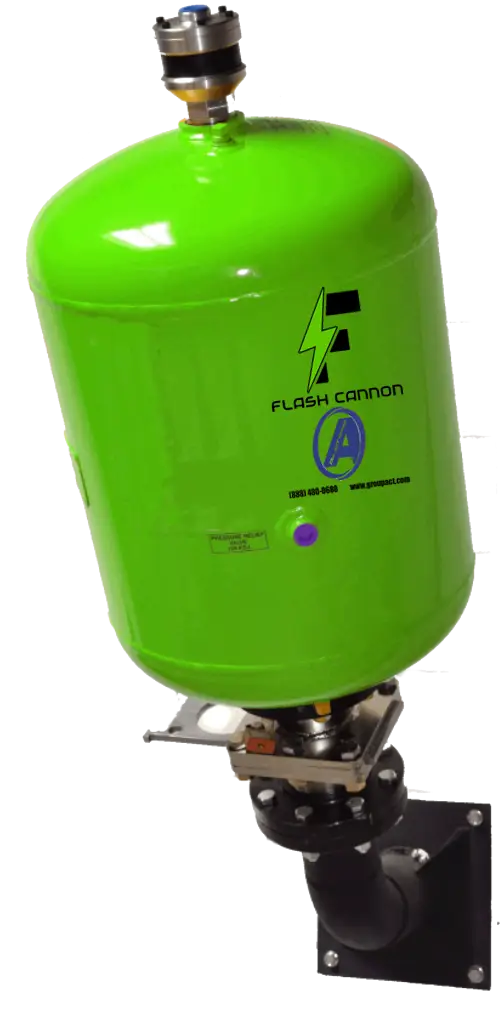

The Flash Cannon — Air Cannon by ACT
The Flash Cannon is our own air cannon — a compressed-air blast aerator engineered to break bridged, ratholed, and stuck material loose in silos, bins, hoppers, and chutes. When the solenoid fires, the tank dumps its stored air in under half a second, driving a cone-shaped blast into the buildup right where it forms. Material moves, flow resumes, and nobody climbs into the vessel with a pole.
We have built our air cannon business on this unit for over a decade: we size it, install it, sequence it, and keep every wear part for it on the shelf in Fontana.
How It Works
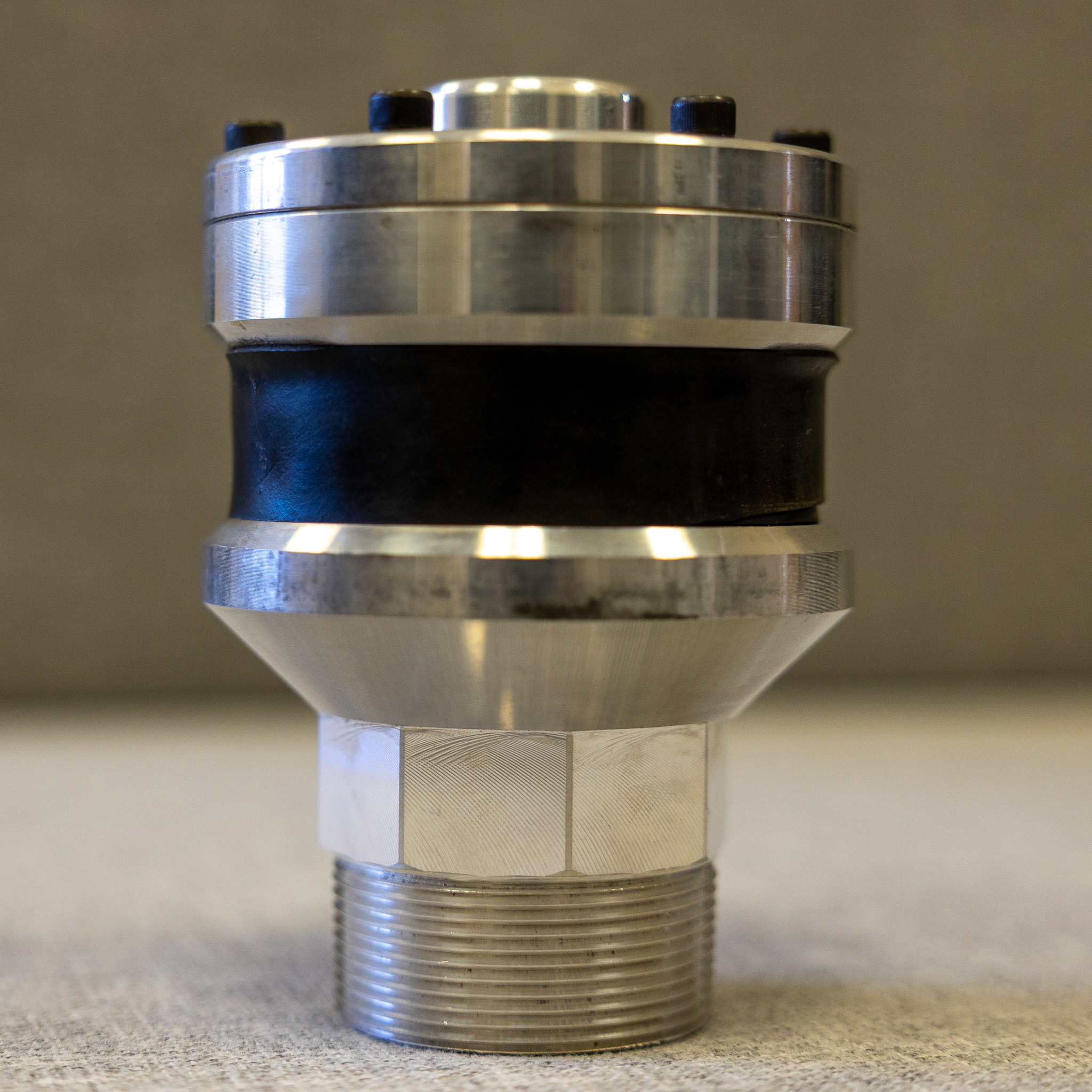
A Flash Cannon is a pressure vessel, a valve, and a nozzle — and only one moving part. The tank charges from your plant air through a quick-fill port in under 60 seconds. On the fire signal, the springless piston valve snaps open and releases the full charge in roughly 0.44 seconds, producing up to 3,965 pounds of force at 100 psi on the largest model, with a circle of influence beyond 16 feet depending on material density. O-ring seals hold the charge between shots, so the cannon is not bleeding your compressed air all shift.
Key Features
- One moving part — springless piston valve with no motors, springs, or bearings to fatigue and fail.
- Full-force discharge — the complete tank dumps in a single sub-half-second pulse instead of a slow hiss.
- Low air consumption — sealed storage and fast refill keep demand on your compressor modest.
- Quiet in service — the blast fires into material, and the material dampens the noise.
- Serviceable forever — every component is individually replaceable, and we stock the parts.
- Remote-mount solenoid option — with the quick exhaust valve, the solenoid can sit up to 100 feet from the tank, away from heat and dust.
- ASME-certified vessel — every tank conforms to ASME Code for Pressure Vessels, Section VIII, Division 1, with documentation available on request.
Specifications
| Operating pressure | 40–120 psi (2.8–8.3 bar) |
| Peak blast force | Up to 3,965 lb (17.6 kN) at 100 psi, largest model |
| Discharge time | Approx. 0.44 second full-tank release |
| Circle of influence | 16+ ft (4.9 m), greater in low-density material |
| Tank sizes | 19, 49, 100, 142, 299, and 645 liters |
| Discharge sizes | 2.5″, 4″, and 6″, direct or remote-solenoid fire |
| Operating temperature | 0°F to 130°F (–18°C to 54°C) |
| Air supply | Filtered plant air; no lubrication required |
| Refill | Quick-fill port, tank ready in under 60 seconds |
| Vessel certification | ASME Section VIII, Division 1 |
Where It Earns Its Keep
Cement and clinker silos, biomass and wood chip bins, green sand hoppers, rice hulls, aggregate chutes, concrete bunkers, and ground storage piles — anywhere material bridges over an outlet, hangs up on a vessel wall, or needs aeration without compaction. Air cannons are the answer where vibration is impractical, or where a vibrator would pack the material tighter instead of moving it.
Frequently Asked Questions
How many cannons do I need, and where do they go?
That depends on vessel geometry, outlet size, and how your material behaves — placement matters more than count. We walk the vessel, find where the buildup actually forms, and give you a written recommendation for placement, tank sizing, and firing sequence before you buy anything. That assessment is part of our air cannon service.
Will the blast damage my silo?
No — a properly placed cannon relieves buildup with a controlled air pulse instead of the structural stress of hammering vessel walls. The blast is engineered to move material, not steel. Correct placement and sequencing are what keep it that way, which is why we start with an assessment.
What air supply does it need?
Ordinary filtered plant air between 40 and 120 psi. No lubrication is required, and the quick-fill port has the tank recharged in under a minute, so a modest compressor keeps a whole battery of cannons ready.
What maintenance does it take?
Very little — there is one moving part. The items that eventually wear are the o-rings, the quick exhaust valve, and the mount gasket, and we stock all of them. If a cannon starts hissing instead of firing, the QEV is the first thing to check.
Can you upgrade the air cannons I already have?
Usually, yes. Existing installations rarely need to be torn out — we retrofit worn valves, seals, and outdated controls on most major brands, and adapt older tanks to current parts that ship from stock.
Do you install and service what you sell?
Yes. Our own MSHA and OSHA trained technicians handle installation, firing sequence tuning, preventive maintenance, and emergency response. One example: our air cannon service work for CalPortland Cement.
Everything For It, In One Place
- Quick Exhaust Valve (QEV) — the heart of the discharge, in stock.
- O-Ring Replacement Kit — fresh seals, full charge held.
- 4″ Mount Gasket — seals the cannon to the vessel wall.
- Safety Cable Kit — restraint hardware for every install.
- Air Cannon Service — assessment, installation, sequencing, and maintenance by our crews.
- All air cannon parts — the full category, priced online.